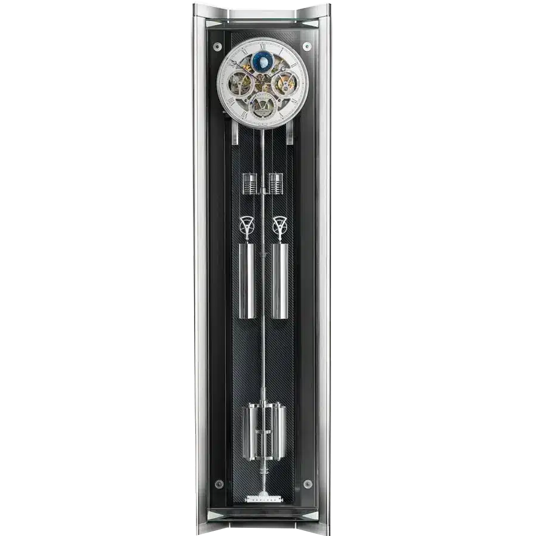
Opus Perpetual
描述
HIGHLIGHTS
- Perpetual calendar, metal bar (Aluminium), tubular gong
- Funnel-shaped starry sky with 10 diamonds, 6 jubilee jewels as indexes
- Limited to 60 pieces
THIS COMPLEX WORK OF ART FEATURES A PERPETUAL CALENDAR − FROM WHICH THE OPUS PERPETUAL TAKES ITS NAME
PERPETUAL CALENDAR
HOW DOES THE PERPETUAL CALENDAR IN THE CALIBRE 2051 WORK? In the calibre 2051 by the Erwin Sattler manufacture, the central hour wheel drives the calendar mechanism. This turns on its own axis once every 12 hours, making it necessary to halve the rotational speed just once every 24 hours in order to advance the indicators correctly. To account for the peculiarities of the Julian calendar, in which months have different lengths and there is a leap year after three normal years of 365 days, a component known as a month cam is required. Ridges and indentations signal how long the relevant month is to the main switching lever, which “feels” the edge of this specially shaped component. Since February has 28 days three times and then 29, a four-year wheel is needed too, which rotates 90 degrees a year in a cut-out on the month cam.
At the end of the month, the main switching lever works together with a toothed snail disc. In months that have 31 days, which are marked by ridges on the month cam, the pawl of the main switching lever moves completely normally over the tooth, advancing the date and month indicators by one position as it does so. If a month has less than 31 days, however, the rear end of the main switching lever moves deeper into the month cam accordingly. This makes it go back further, so the pawl moves over the aforementioned tooth after 30, 29 or 28 days instead, thereby advancing the calendar to the first day of the following month. The day and month displays remain unaffected by this. The calendar mechanism moves one position on every day.
AN ABSOLUTE MASTERPIECE OF CRAFTSMANSHIP. THIS COMPLEX WORK OF ART FEATURES A PERPETUAL CALENDAR − FROM WHICH THE OPUS PERPETUAL TAKES ITS NAME
The advancement of the Opus Perpetual’s eponymous calendar, which is made up of 130 components, is truly a masterstroke of engineering. For energy reasons, advancement takes several hours for other movements, with the hands moving from one position to the next very slowly. This is not the case with the sensational precision pendulum clock from Erwin Sattler, however, thanks to its special design. Its movement features a melodious strike train too, which announces the full and half hours with sound. A separate weight even guarantees propulsion over 30 days. Its mass generates enough force to advance the calendar mechanism to the next day in just 12 seconds − i. e. during the 12 strikes at midnight − and also to the next month. The precision of the movement therefore remains completely unaffected.
The strike train in the Opus Perpetual offers yet another special feature. In contrast to simple designs that have a countwheel, the elaborate rack and snail mechanism guarantees that the clock will strike the correct hour even if the hands are moved forwards or backwards without waiting for the sequence of chimes to finish. A tubular gong provides pleasant sound quality. Should the clock’s owner only wish to enjoy its soft ticking, however, the strike train can be suppressed with a simple hand movement.
The beating heart of the precision pendulum clock is the calibre 2051, which is made in-house. Comprising 601 components in total, it is one of the most complex movements that clock manufacturer Erwin Sattler has ever produced. It goes without saying all parts are made of the very finest materials available, finished with care and lovingly put together. The wheels rotate between solid brass plates that are 4 mm thick. An electroplated nickel coating provides protection against oxidation. To reduce the masses in motion, the 24 gold-plated gear wheels are spoked as much as is technically feasible and sit upon solid, fully hardened steel arbors with precisely milled pinions. 48 stainless steel precision ball bearings and four chatoned jewel bearings ensure almost frictionless rotation. These elaborate measures serve to achieve functional perfection, reducing energy loss to an absolute minimum. The George Graham lever escapement has two agate pallets. A seconds pendulum with a 12 mm-thick invar rod, a steel-nickel alloy with minimal thermal expansion coefficients and a steel element to compensate for unavoidable fluctuations in temperature act as an oscillator.
The accuracy of the pendulum clock can be affected by changes in the air pressure too, which is why the Opus Perpetual has a bilateral barometric compensator on the pendulum rod: When the air pressure rises, the aneroid capsules are pushed together. This causes the weights on the capsules to move downwards, shifting the entire pendulum’s centre of gravity accordingly. Similarly, the two weights are raised when the air pressure falls. The two tungsten weights (weighing 6,800 g each) for the gravity drive are attached to ball-bearing rope pulleys. These sophisticated structures have a positive effect on accuracy, and providing the Opus Perpetual is regulated carefully, its monthly drift is as low as one or two seconds.
The Opus Perpetual also takes its exceptional aesthetics from its attractive case, which protects and houses the technologically impressive movement. Made from massive aluminium, the 152 cm-high, 39 cm-wide, 22 cm-deep case will draw the eye to any wall it is placed against. The look is completed by a lively olive root wood cassette, while the pane of antireflective mineral glass provides a tantalising glimpse inside. On request, the cassette can also be made in a different wood or in carbon. To celebrate its anniversary fittingly, the Erwin Sattler manufacture is making only 60 Opus Perpetual timepieces. The number of each piece is indicated by a plaque at the “6” on the skeletonised dial.
Case: - Metal bar (Aluminium) with olive root wood cassette, hand-polished - Metal bar (Aluminium) with carbon cassette, hand-polished Height: 150 cm, width: 40 cm, depth: 23 cm
Crystal: Mineral glass, anti-reflective
Power reserve: 30 days
Drive: Weight going train 6,800 g with pulley, weight strike train 6,800 g with pulley
Oscillator: Invar pendulum Ø 12 mm, temperature and air-pressure compensation with twin barometer
Ball bearing: 48 precision ball bearings
Jewel bearing: 4 in screwed-in chatons, 2 agate anchor pallets
Dial: Anodised, skeletonised, three-dimensional moon phase with 10 diamonds (0.10 ct), funnel-shaped starry sky, perpetual calendar, seconds dial, 6 jubilee jewels as indexes, jubilee button
Hand: Blue steel hands, hand domed
Strike train: Half-hour rack strike train with tubular gong, strike train silencer
Weight: 72 kg
強調重點
- 萬年曆 金屬棒 (鋁) 管狀鐘鑼
- 漏斗狀星空 10 顆鑽石 6顆特別周年寶石來做時標
- 全球限量60台
這件複雜的藝術作品以萬年曆為特色——作品《萬年曆》(Opus Perpetual)的名稱也由此而來。
這精確鐘擺機械掛鐘的工藝是絕對傑作. 令人印象深刻的尺寸、獨特的設計和現代美學. 這款機械掛鐘為買者提供了他們可能需要的所有資訊。迷人的鐘面的指針分別指示時、分、秒。 同樣用精美時尚的設計顯示出星期幾、月份和精準日期。
萬年曆
Calibre 2051 的萬年曆是如何運作的?
當使用Erwin Sattler Calibre 2051 機器時, 會發覺中央時輪驅動日曆機構. 它每12小時繞軸線旋轉一週。 因此,為了使指示器正確運轉,只需每24小時將轉速減半一次即可。特殊性的儒略曆, (因為月份的長度各不相同,每連續三個365天之後就會出現閏年,因此需要一個名為「月份凸輪」的組件)。 月份凸輪會有這個特殊形狀部件的邊緣。(凸脊和凹痕指示相關月份與主切換桿之間的距離)。 由於二月有三次是28天,然後又有一次是29天,所以也需要一個四年周期的轉盤. 它在月份凹槽內每年旋轉90度。
主開關桿與齒輪蝸輪盤配合工作在每個月底。 每當月到達31日時, 主開關桿會正常活動到向前移動齒輪一位(有凸脊指示)。 但是,如果某個月份的天數少於 31 天,則主開關桿的後端會相應地更深地移入月份凸輪中。 這樣一來,它就會向前移動更遠,因此棘爪會在30、29或28天後移動到前面提到的那齒輪上,從而將日曆推進到下個月的第一天。 日期和月份的顯示不受影響。日曆機制每天都會移動一格。
一件工藝精湛的傑作。這件複雜的藝術品以萬年曆為特色——作品《萬年曆》(Opus Perpetual)的名稱也由此而來。
仔細觀察精巧鏤空的錶盤,你會發現月份指示器軸下方還有第四個日曆顯示,其中四個區域分別標示為 1、2、3 和 L。“萬年曆”正是由此得名。鐘錶愛好者會立刻知道,這是三個年和一個閏年的顯示,這意味著這件複雜的藝術品具有萬年曆功能. 買者無需任何額外操作,就能享受這巧妙設計日曆機制帶來的便利,直至2100年2月底。
這款掛鐘搭載由601個零件組成的2051型機器,擁有長達30天的動力儲存,這意味著佩戴者幾乎無需過多照料。即使腕錶在主人長時間外出時停止運行,獨立的校正器也能輕鬆幫助其隨後校正日期、月份和星期。鐘面上精美的3D月相顯示更添光彩,其中“12”點鐘位置的手繪旋轉球與神秘的月亮極為相似。 月相的準確性及其外觀都非常重要。一個藍色的漏斗狀天空圓鐘面為月相顯示提供了相稱的背景,上面鑲嵌著十顆0.1克拉的小鑽石,象徵著天空中閃耀的星星。 另外六顆週年紀念鑽石作為偶數小時的閃爍指示器。
Opus Perpetual 同名日曆由 130 個組件構成,其發展堪稱工程學上的傑作。出於能量上的考慮,其他動作的推進需要幾個小時,分時針從一個位置移動到下一個位置的速度非常慢。(Erwin Sattler) 特殊設計的這款令人驚豔的精確鐘擺掛鐘不會有這問題. 它的機器還配備了悅耳的報時裝置,有敲打音樂報時,報時時間為整點和半點。 單獨的鐘錘甚至可以保證動力持續30天。 它的質量產生的力量足以在短短 12 秒內將日曆機制推進到第二天——即午夜 12 次敲響期間——並推進到下個月。因此,機器的精確度完全不受影響。
Opus Perpetual 的報時裝置還具有另一項特殊功能。 Opus 的機器有精密的齒輪和蝸形凸輪機構保證. 如果不等報時序列結束而指針向前或向後撥動時,時鐘也能準確報時。然而,如果鐘的主人只想欣賞它輕柔的滴答聲,只需簡單地移動一下分時針,就可以抑制報時裝置。
精確鐘擺掛鐘的核心零件是2051型機芯。 機芯總共由 601 個零件組成,是鐘錶製造商 Erwin Sattler 生產過的最複雜的機芯之一。 所有零件均採用最優質的材料製成,精心打磨,並用心組裝。 齒輪厚度為 4 毫米的實心黃銅板之間旋轉。電鍍鎳層可提供抗氧化保護。 為了減少質量傳輸,24 個鍍金齒輪盡可能地採用輻條式設計,並安裝在堅固的、完全硬化的鋼軸上,軸上裝有精密銑削的小齒輪。48 個不銹鋼精密滾珠軸承和 4 個寶石軸承確保了幾乎無摩擦的旋轉。 這些精心設計的機器在實現功能上的完美,將能量損失降到絕對最低限度。喬治·格雷厄姆 (Graham lever escapement)槓桿式擒縱機構有兩個瑪瑙托盤. 秒擺由一根 12 毫米厚的因瓦合金桿 (invar rod)、一種物質受溫度變化影響的最小的鋼鎳合金以及一個鋼元件組成,用於補償不可避免的溫度波動,它充當振盪器。
掛鐘的精確度也會受到氣壓變化的影響,因此 Opus Perpetual 在鐘擺桿上配備了雙側氣壓補償器:當氣壓上升時,無液氣壓囊會被推在一起。這會導致鐘殼上的重物向下移動,從而使整個擺錘的重心移動。當氣壓下降時,兩個鐘錘會上升。用於鐘錘驅動的兩個鎢塊(每個重 6,800 克)安裝在滾珠軸承繩索滑輪上。 精密的結構對精度有正面影響,只要對 Opus Perpetual 進行精心調校,其誤差可低至一到兩秒。
Opus Perpetual腕錶卓越的美學設計也源自於其精美的錶殼,保護並容納了技術精湛的機芯。 這款由厚重鋁材製成的掛鐘高 152 厘米,寬 39 厘米,深 22 厘米,無論擺放在哪面牆上,都能吸引人們的目光。 生動的橄欖根木盒式外殼使整體造型更加完美,而防反射礦物玻璃面板. 整台掛鐘組合起來令人心動. 外殼也可以用其他木材或碳纖維製成。 為了隆重慶祝其周年紀念,Erwin Sattler 僅生產全球限量 60 台 Opus Perpetual 掛鐘。每個掛鐘的編號都由鏤空鐘面上「6」字處的銘牌標示。
顏色: 金屬棒 (鋁) 手拋光 橄欖根木鐘盒 金屬棒 (鋁) 碳纖維鐘盒 手拋光
尺寸: 150 x 40 x 23 公分
水晶: 防反射 礦物玻璃
動力儲存: 30天
鐘錘: 1 個6.8 公斤 機器功能鐘錘 滑輪帶動 1個6.8公斤 報時功能鐘錘 滑輪帶動
振盪器: 殷鋼鐘擺 12mm, 溫度和氣壓補償 氣壓顯示 雙氣壓計
滾珠軸承: 48顆精密準確滾珠軸承
寶石軸承: 4顆寶石軸承鎖進寶石鑲座 2顆瑪瑙錨棘爪 (錨定板)
鐘面: 陽極處理 骨架式 3D 月相顯示 10 顆鑽石 漏斗狀星空 萬年曆 秒針鐘面 6顆特別周年寶石來做時標 紀念型寶石
分時針: 藍鋼分時針 手工圓頂
敲打功能: 每30分鐘 敲打管狀鐘鑼 靜音功能
鐘錘: 72 公斤


商品評價
目前沒有評價。